

Long before modern cafés began crowning lattes with hearts and rosettas, ancient Chinese people were already turning a bowl of whisked tea into a canvas for ephemeral art. Known as 茶百戏, this art relied on the foam created through dian cha, a whisking powdered-tea practice that began in the Tang dynasty (618 - 907). On that green-tinted foam, plain water served as an invisible ink, tracing lighter lines and forms into the tea’s surface.
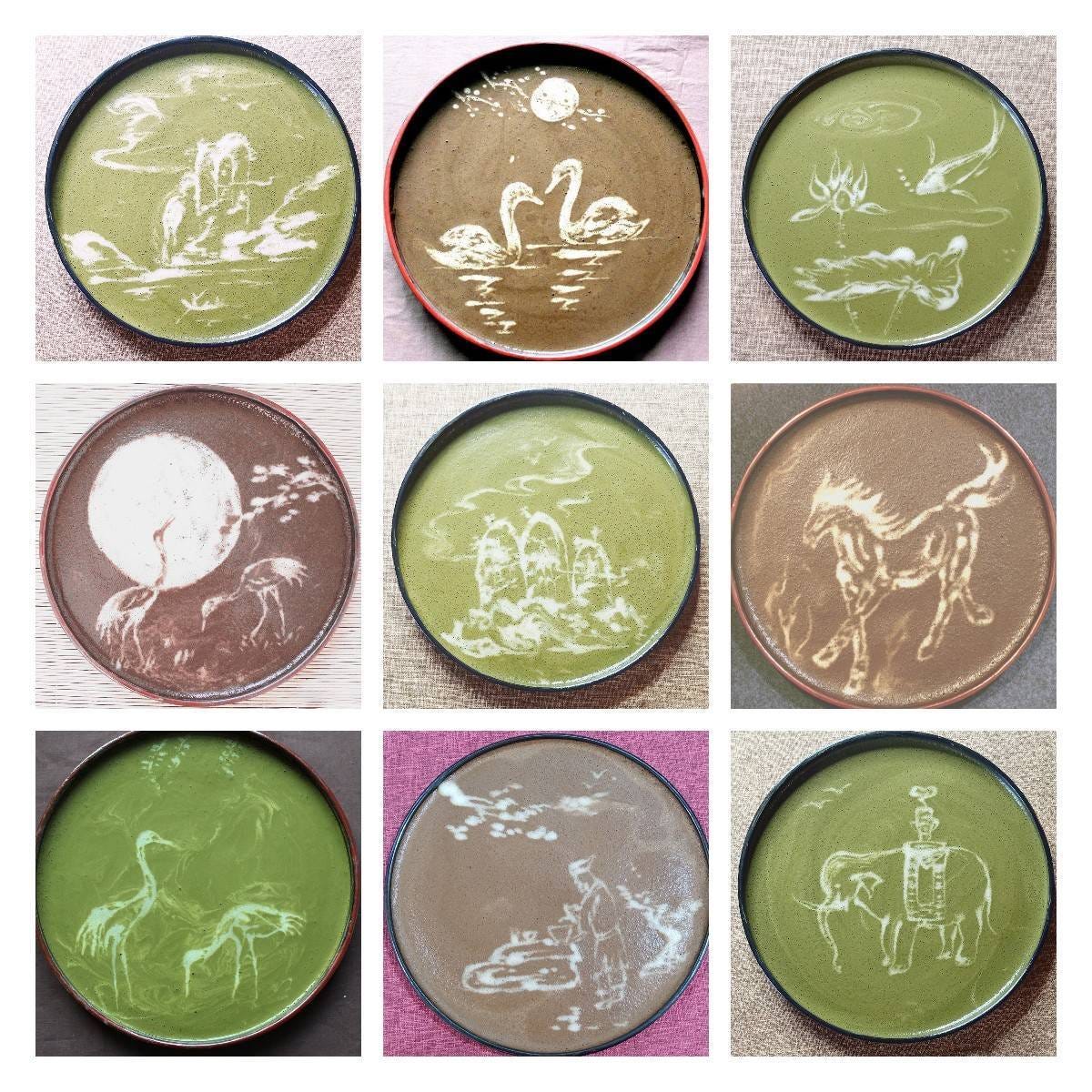
The practice of 茶百戏 belongs to the world of whisked powdered tea, where plain water could be used to draw pale lines and forms across the dark foam of the tea itself. The term translates literally as “Tea’s One Hundred Plays.” It was also known as 分茶 (“splitting tea”) and 水丹青 (“water-borne painting”).
One of the earliest extant descriptions of this ephemeral art appears in Liu Yuxi’s (772–842) poem, Song of Tasting Tea at the Xishan Monastery (西山兰若试茶歌): “骤雨松声入鼎来,白云满碗花徘徊.”
Water rises in the cauldron like sudden rain through the pines.
White cloud fills the bowl,
as flower-like forms linger on the tea.
The practice receives its clearest early naming in Tao Gu’s (903-970) Record of Tea (荈茗录): 茶至唐始盛。近世有下汤运匕,别施妙诀,使汤纹水脉成物象者,禽兽虫鱼花草之属,纎巧如画,但须臾即就散灭,此茶之变也。时人谓之「茶百戏」。
Tea began to flourish in the Tang dynasty. In more recent times, some developed a special technique: by adding hot water and working the tea spoon across the surface, they made the tea’s patterns and watery traces form images of birds, beasts, insects, fish, flowers and grasses. Exquisite as paintings, the art dispersed within moments. This was tea in transformation. People of the time called it “Tea’s One Hundred Plays.”
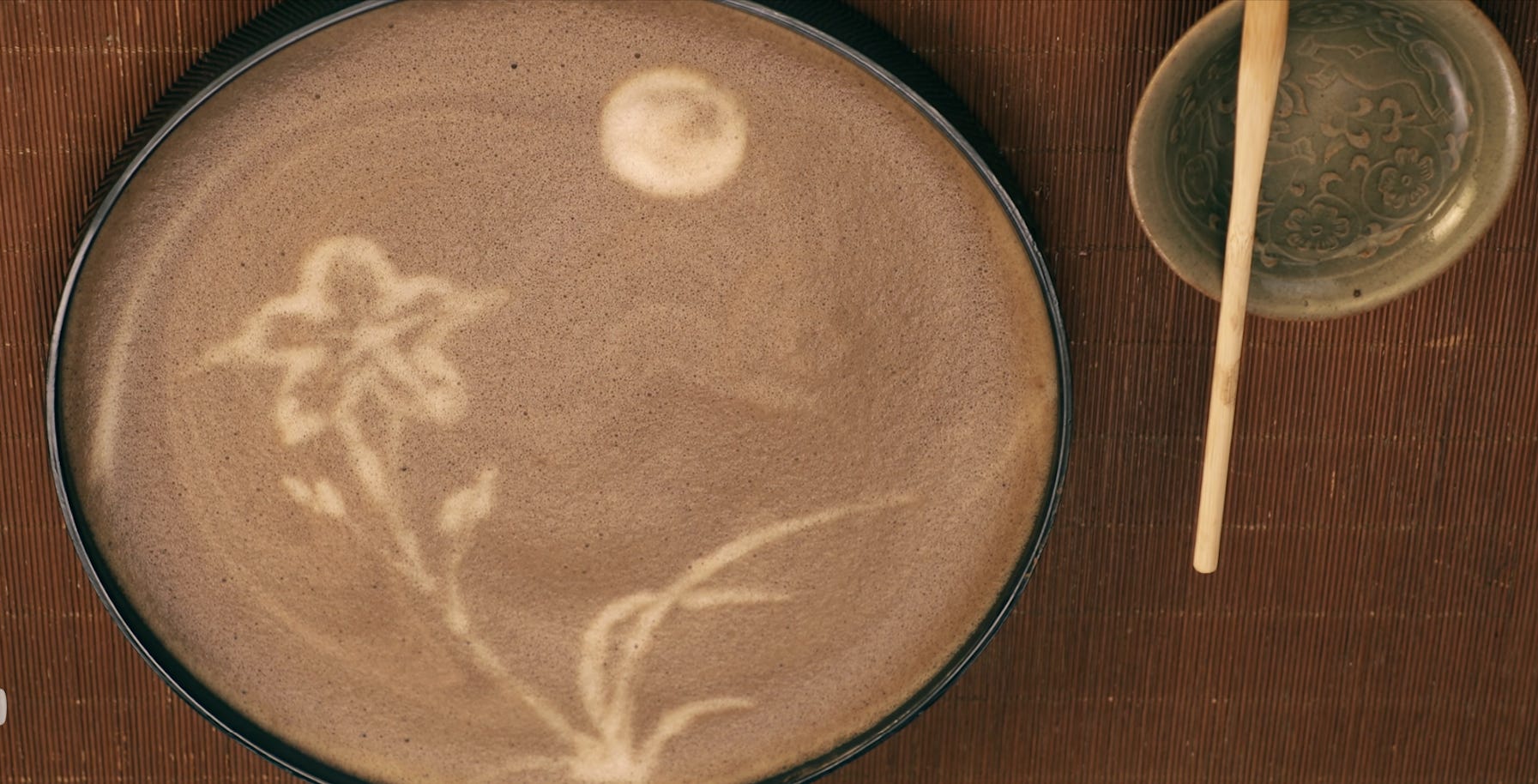
What makes the effect so captivating is that it seems almost magical: water alone can turn green foam pale. Yet the visual effect likely rests on a fairly simple piece of physics.
Tea appears green because more green light makes it back to your eyes, while more of the other colors are absorbed. Dense foam works differently. In a foam packed with tiny bubbles, light of all colors is scattered in many directions, so the foam naturally looks white.
In whisked tea, those bubbles are surrounded by tea-rich liquid and fine tea particles, which tint the foam green. When a little plain water is added, it likely rinses or dilutes some of that tea color away from the the surface of the foam without immediately destroying the bubbles. In that small area, the bubbles are optically clearer, so their natural white scattering shows through more strongly. That is why a pale mark can suddenly appear.
In many modern examples, the method has shifted. A dense paste of tea is prepared first, then applied like ink over a field of white foam. Compared with the older water-only technique, this creates stronger contrast and allows much greater control over the final image.
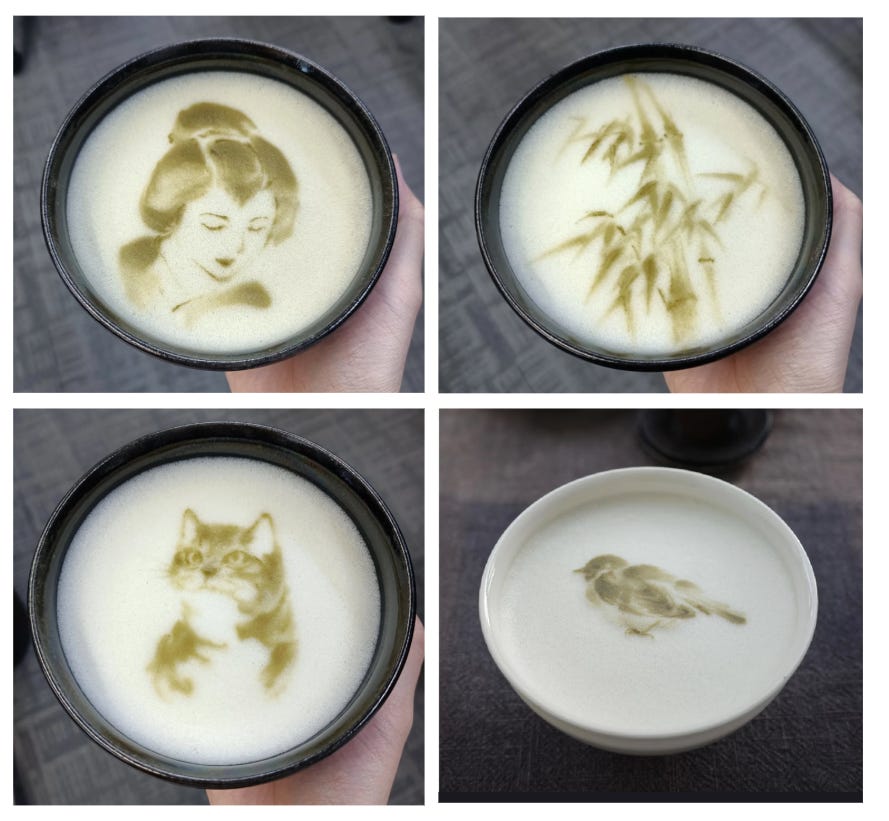
It is remarkable that ancient Chinese tea drinkers noticed this transformation, refined it, and turned it into an art. What began as a fleeting change on the surface of whisked tea became a practice with its own names, techniques, and aesthetic vocabulary. In 茶百戏, we glimpse a culture that looked at tea with extraordinary care, finding in the life of foam a source of wonder, craftsmanship, and beauty.
If you want to see it live, check out this video I found on Youtube.
©2026 Studentoftea.com | All Rights Reserved