

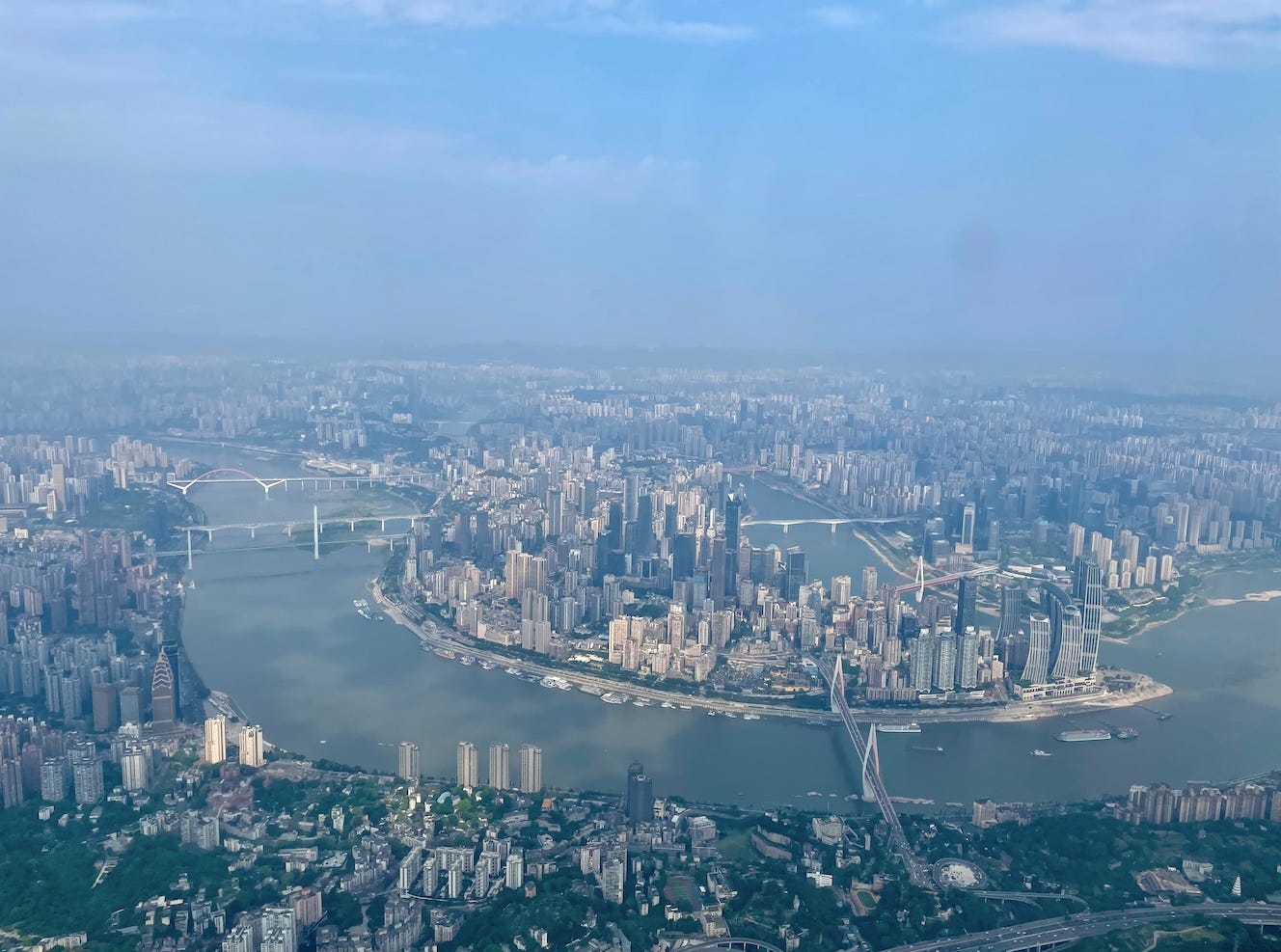
I left one fog city for another. From San Francisco, I flew China Southern to Chongqing, with an early morning layover in Wuhan. As the plane descended, the city came up slowly through a pale haze: rivers curving between steep banks, bridges leaping across valleys, towers rising from the slopes, roads stacked over one another. They call Chongqing 雾都 (wùdū), the fog capital, and its famous 8D verticality made sense before I had set foot on the ground.
This is how I’d spend a few days in Chongqing as a tea lover, following the city’s stairways more than any map.
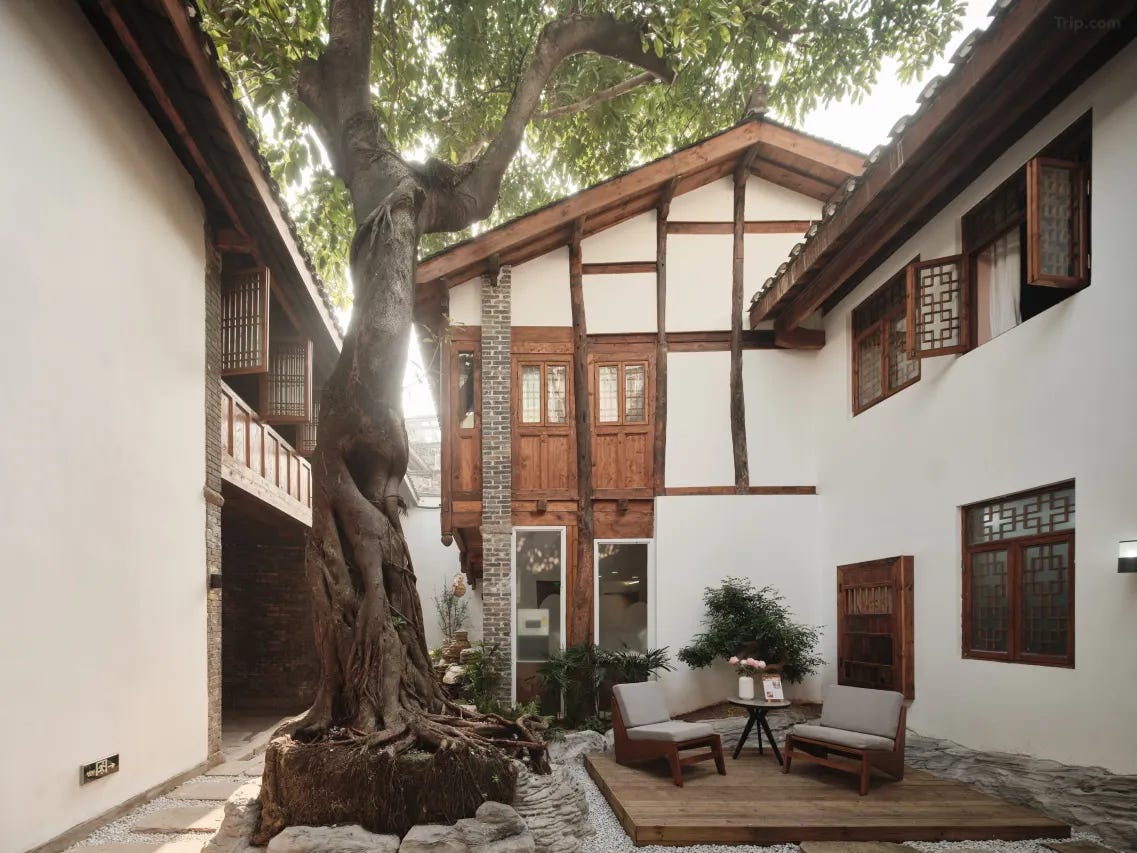
I chose to stay at a small hotel near 山城巷步道 Mountain City Alley, set inside a restored historic building tucked into the hillside. Much of Chongqing is built on mountains, and its old pedestrian paths of steps, slopes, and narrow lanes were once how people moved between homes, markets, and river docks. Staying on one of them gave me a quieter way into the city, and a courtyard to come back to after a day in the old neighborhoods. The establishment checked all my boxes: history, modern amenities, cats.
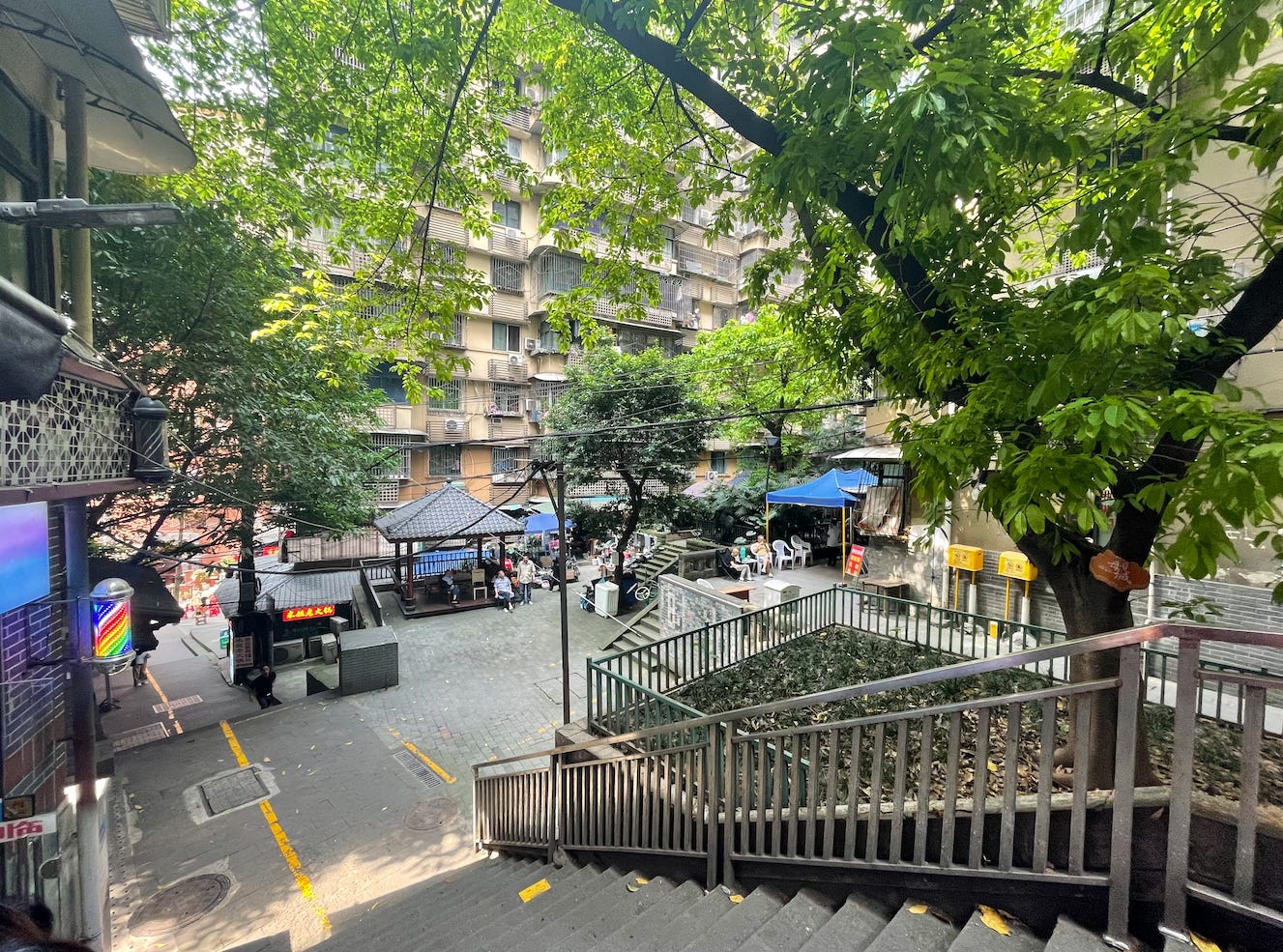
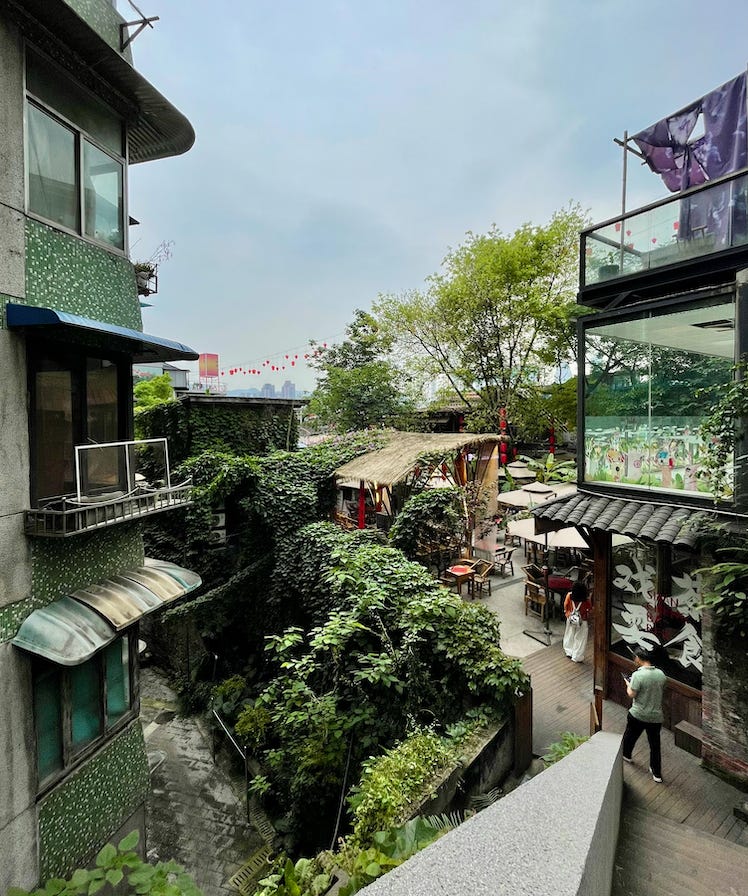
Explore the neighborhood once you’re settled in. One of the most striking features about Chongqing is how closely everything is packed together. Residential buildings, breakfast stalls, noodle shops, teahouses, massage parlors, hair salons, convenience stores, and mahjong rooms often share the same slopes and stairways. The separation between home and street feels softer here than in most cities. You can leave your building, go down a few steps for breakfast, climb another set of stairs for a haircut, then spend the afternoon at a nearby teahouse playing mahjong with neighbors who seem to have been coming to the same table for years. Chongqing does not unfold in neat blocks. So embrace the rises, drops, turns, and layers!
Of course, within five minutes of leaving the hotel, I had already run into the first tea stop: 山城坝坝茶 Shancheng Baba Tea. 坝坝茶 bàbà chá is hard to translate neatly. 坝坝 bàbà means a flat open space, but in Chongqing, any flat ground is hard to come by. Here, a bàbà can be beside a road, near an old dock, outside someone’s doorway, or along a few stone steps, as long as there is open air and a place to sit and sip. At Shancheng Baba Tea, the local teahouse vocabulary appears all at once: bamboo chairs packed close together, small tables set with gaiwan 盖碗 (lidded tea bowls), plates of snacks (a lot of guazi), Sichuan opera’s iconic face-changing act, Bian Lian 变脸, and tea poured from a long-spouted copper kettle.
The long-spouted copper kettle is not all theater. Servers swing it in wide arcs, sending a narrow stream of hot water into the gaiwan from surprising distances. The choreography draws the eye, but the tool also makes practical sense: in a crowded teahouse, a long spout lets the server refill cups without leaning over guests or interrupting the table.
In the late Qing, after Chongqing was opened as a treaty port under the unequal treaty system, this part of the old city began to accumulate new kinds of buildings along its slopes: missionary compounds, churches, schools, private residences, and commercial spaces, some of which still shape the area today. One quiet stop is the former site of 金马寺小学 Jinmasi Primary School, now home to a small museum, library, and café. It is not a major attraction, which is part of its appeal. The museum has the feeling of a neighborhood memory room, with old telephones, pagers, MP3 players, stamps, food coupons, and other everyday objects displayed less like precious artifacts than things someone still remembers using. The library keeps some of the old classroom atmosphere too, with shelves of older books arranged among the original school furniture, plus a cat who seems to have taken on librarian duties. It is a good place to sit for a while, let the nostalgia do its quiet work, and then continue through the alleys.
In general, I would not over-plan Chongqing’s older residential neighborhoods. Wandering is part of the experience. If you are not especially comfortable with stairs, though, it is worth planning your route so you walk mostly downhill.
Take a sunny day to follow the city toward the river. Start in the morning at 湖广会馆 Huguang Guild Hall, one of the clearest places to see Chongqing as a migration city. Construction began in 1759, during the Qianlong reign of the Qing dynasty, and the complex is tied to the large-scale migration often called 湖广填四川 Huguang tian Sichuan, “Hunan and Guangzhou fill Sichuan.” The architecture is worth slowing down for: layered courtyards, carved wooden galleries, red curtains, and tiled roofs whose ridges curl upward into dense ornament. From some angles, the old rooflines sit directly against Chongqing’s modern bridges, putting the city’s Qing-dynasty river-trade world and contemporary infrastructure in the same frame. The guild hall also has a teahouse that uses the historic stage for Sichuan opera and long-spouted copper kettle pouring, so the complex does not feel like only a museum. You can sit with tea while a performance returns the courtyard to one of its older functions: a public place for gathering, watching, and lingering.
From Huguang Guild Hall, walk toward The Ropeway of Yangtze River and cross to the south bank. The ride is short, but the view is breathtaking: the Yangtze river below, towers rising on both banks, bridges crossing at different angles, and roads stacked into the slopes. Try to go on a clearer day if you can, since haze can flatten the view quickly. Once you are on the south bank, history-minded travelers can make a short stop at 重庆开埠遗址公园 Chongqing Port Opening Heritage Park, built around the former site of Little & Co. 立德乐洋行. The park preserves a cluster of century-old buildings connected to Chongqing’s forced opening to foreign trade, with restored structures, river views, and exhibition spaces arranged along the hillside.
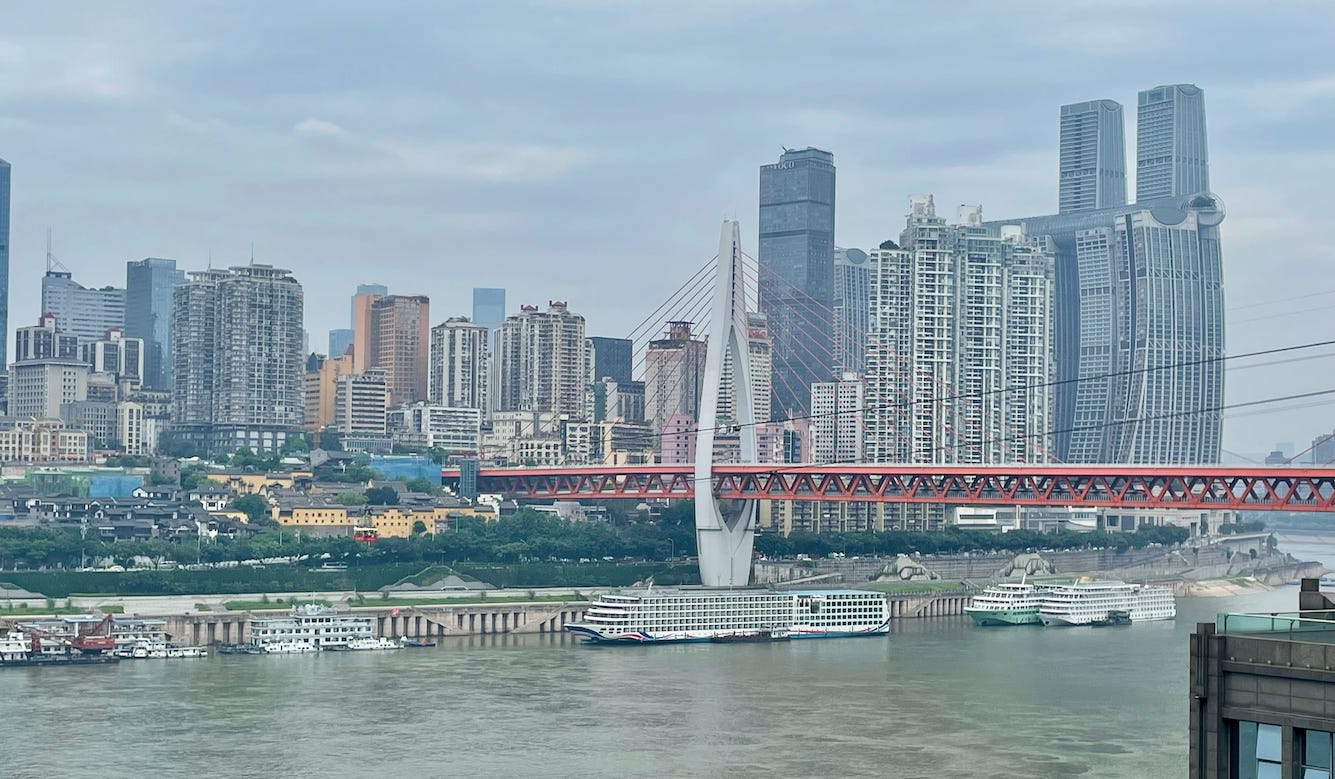
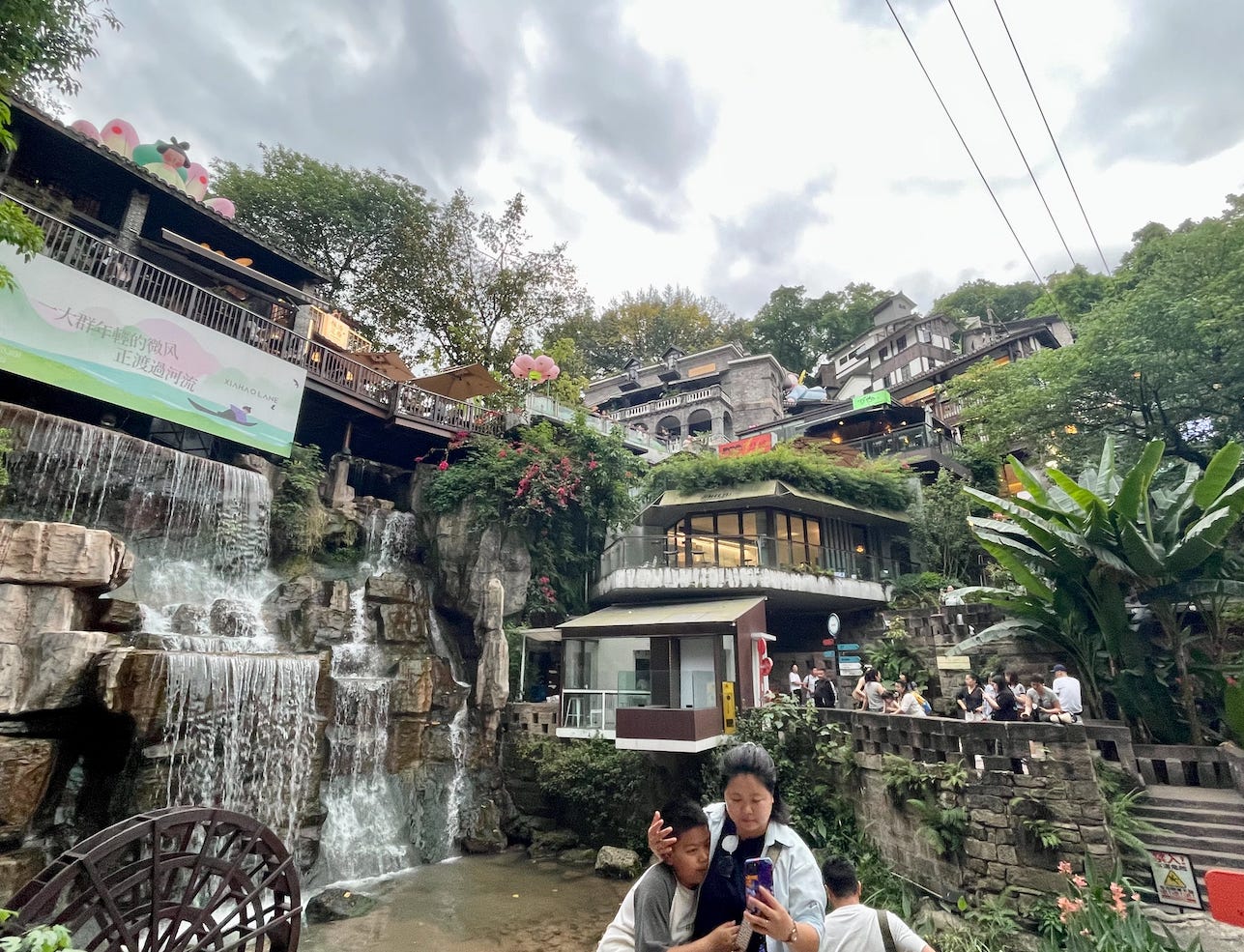
From there, continue toward one of my favorite neighborhoods in Chongqing: Longmenhao Old Street 龙门浩老街 and Xiahaoli 下浩里. The area sits on the south bank of the Yangtze, so almost every turn gives you some version of river, slope, skyline, or old wall. Longmenhao has long been tied to the river. After Chongqing opened up to the world, this stretch of the south bank became one of the places where foreign firms, factories, villas, and mixed Chinese-Western buildings gathered. Today, the restored lanes are easy to wander: stone steps, old houses, terraces, cafés, restaurants, and small shops all layered into the hillside.
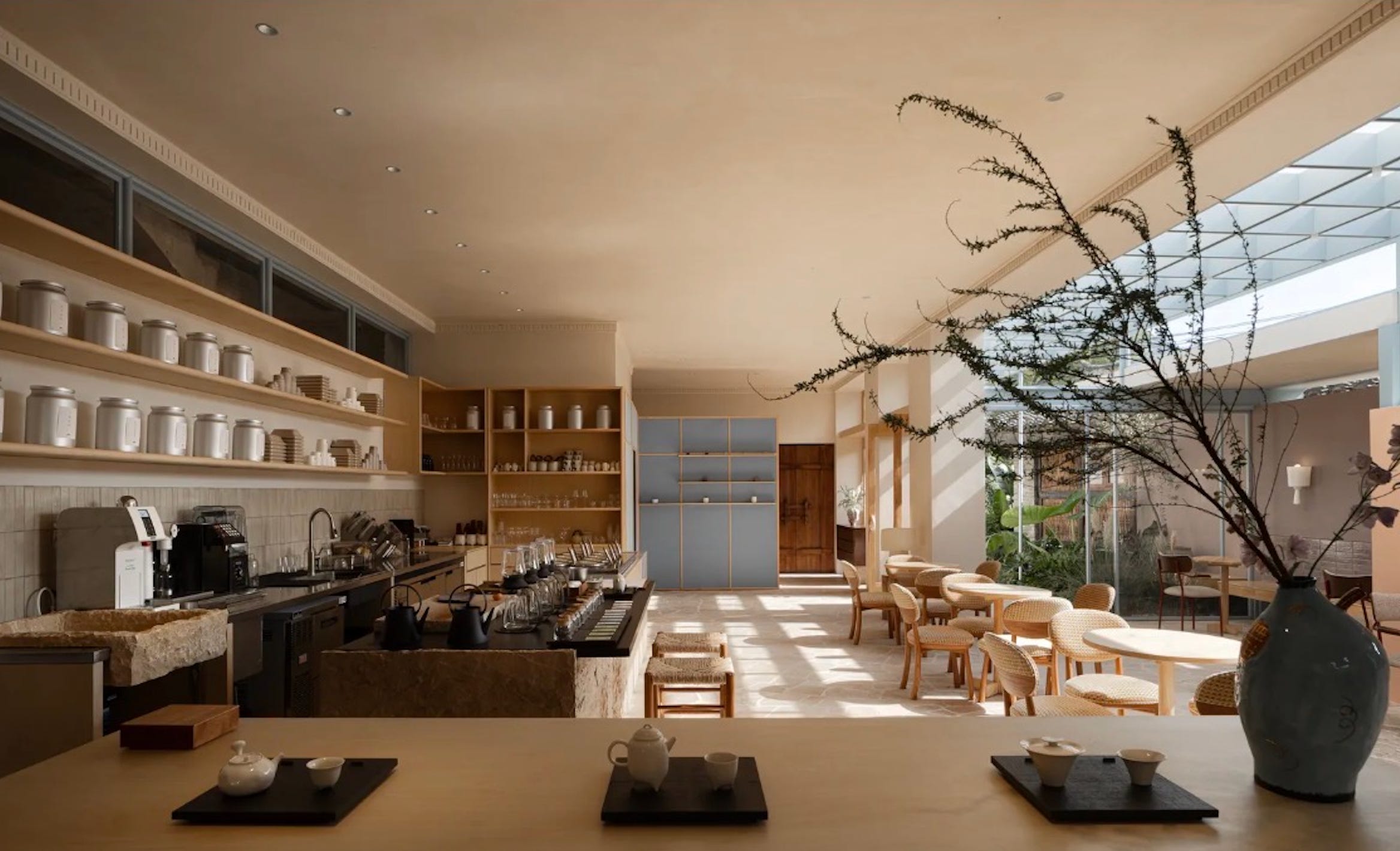
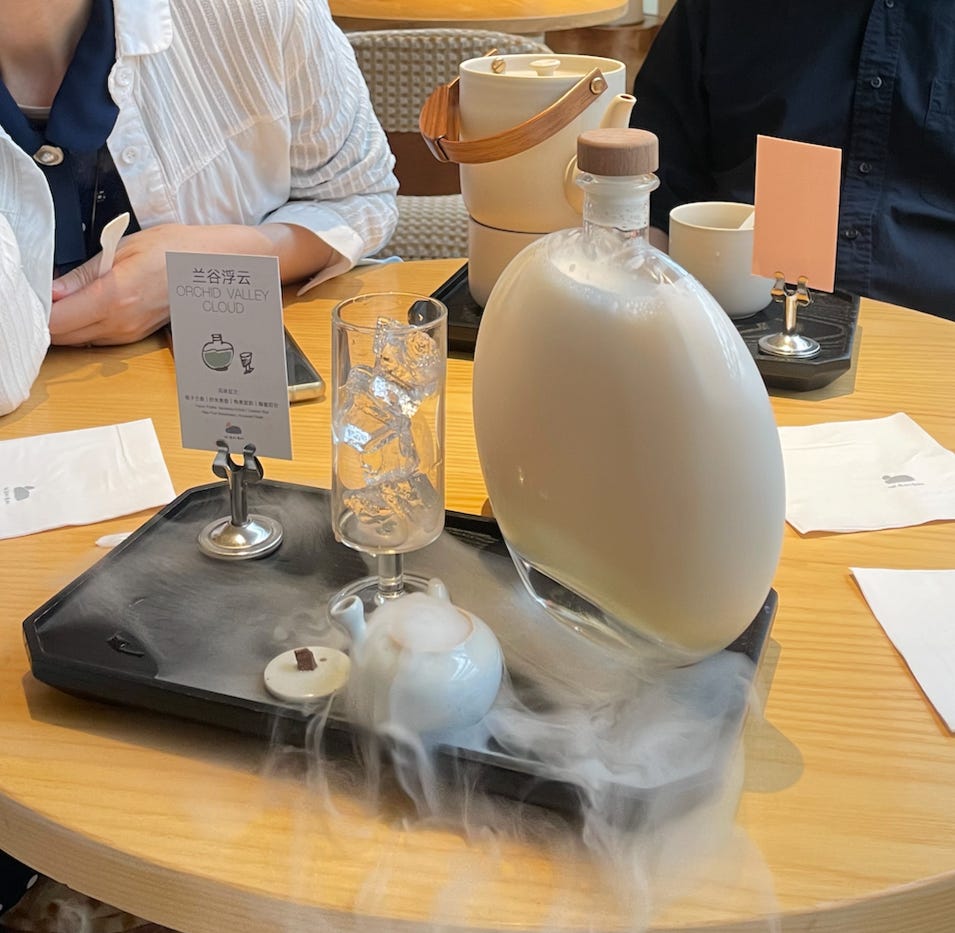
This was also where I found the most contemporary tea stop of my Chongqing stay, 雾白白W. BAIBAI Gelato & Tea, that translates into “white white fog”. I ordered a drink called Orchid Valley Cloud 兰谷浮云, which arrived in a flat, round glass jar that looked more like a perfume bottle than a teapot. The server explained that it could be tasted two ways.oured straight over ice, it tasted like clear brewed tea, light and aromatic. But after shaking the jar hard, the same tea turned cloudy and took on a surprisingly milky flavor, even though no milk had been added. The effect was strange in the best way: same tea, same ingredients, but a completely different impression once air and motion changed how the drink landed on the palate.
After spending time in Chongqing’s older neighborhoods and riverfront sites, I wanted to see the modern, slightly ridiculous side of the city too. This is where you learn an important rule of travel in Chongqing: maps are only moderately helpful. A route may look short, but the city has hidden several flights of stairs, an overpass, a tunnel, and a metro entrance somewhere between you and your destination. Some of the famous sights are cliché by now, but they are cliché for a reason. They are just fun.
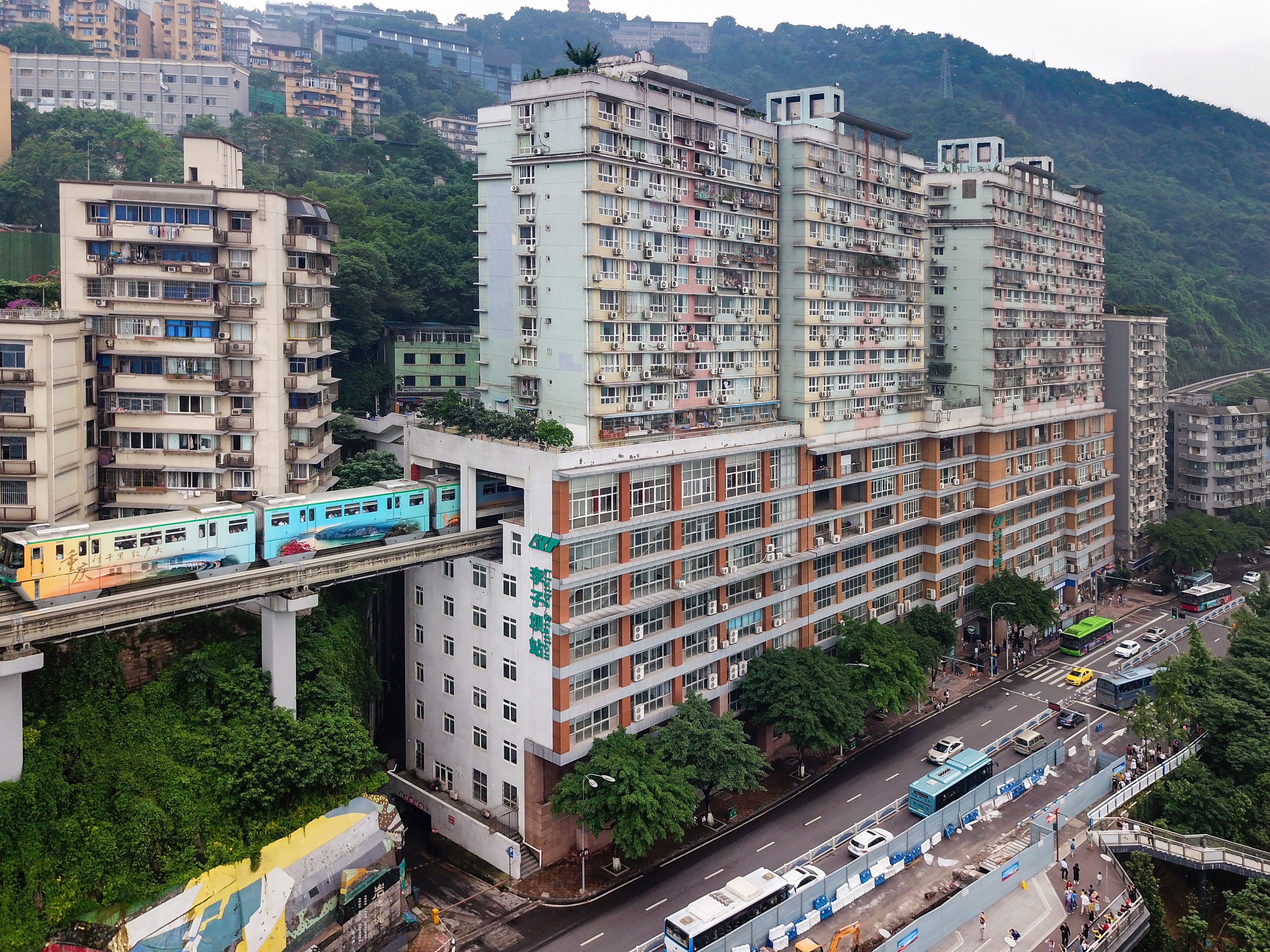
Start with 李子坝 Liziba, where Line 2 of the Chongqing Rail Transit passes directly through a residential building. I took the train from its first stop so I could sit in the front car, which is worth doing if you have an extra fifteen minutes. The ride to Liziba station is short, but the view is fantastic: tracks curving between buildings, the river appearing and disappearing, and the city stacking itself around the line before the train finally slips into the famous station. After you exit, take the direct elevator down toward the Jialing River and head to the viewing platform, where everyone waits for the classic “eating the train” photo.
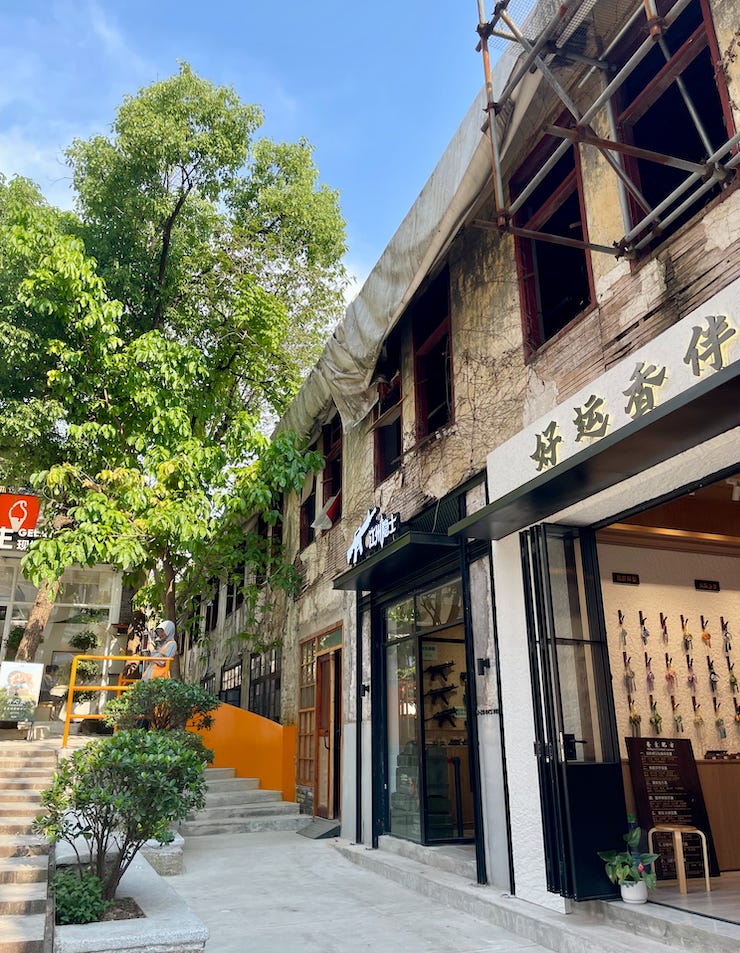
From Liziba station, continue up toward 鹅岭二厂 Eling Factory No. 2, now rebranded as Testbed2. The name sounds casual, but the site once belonged to the the Republic of China Central Banknote Printing Factory. Founded in 1937, it operated during Chongqing’s years as wartime capital, producing banknotes, stamps, and other state documents. In 1953, the site became Chongqing Printing Factory No. 2, and from the 1950s to the 1970s it produced most of the city’s color prints. Today, the presses are gone, and the old factory has been remade into a cultural and creative park, with cafés, shops, studios, and terraces looking out over the city.
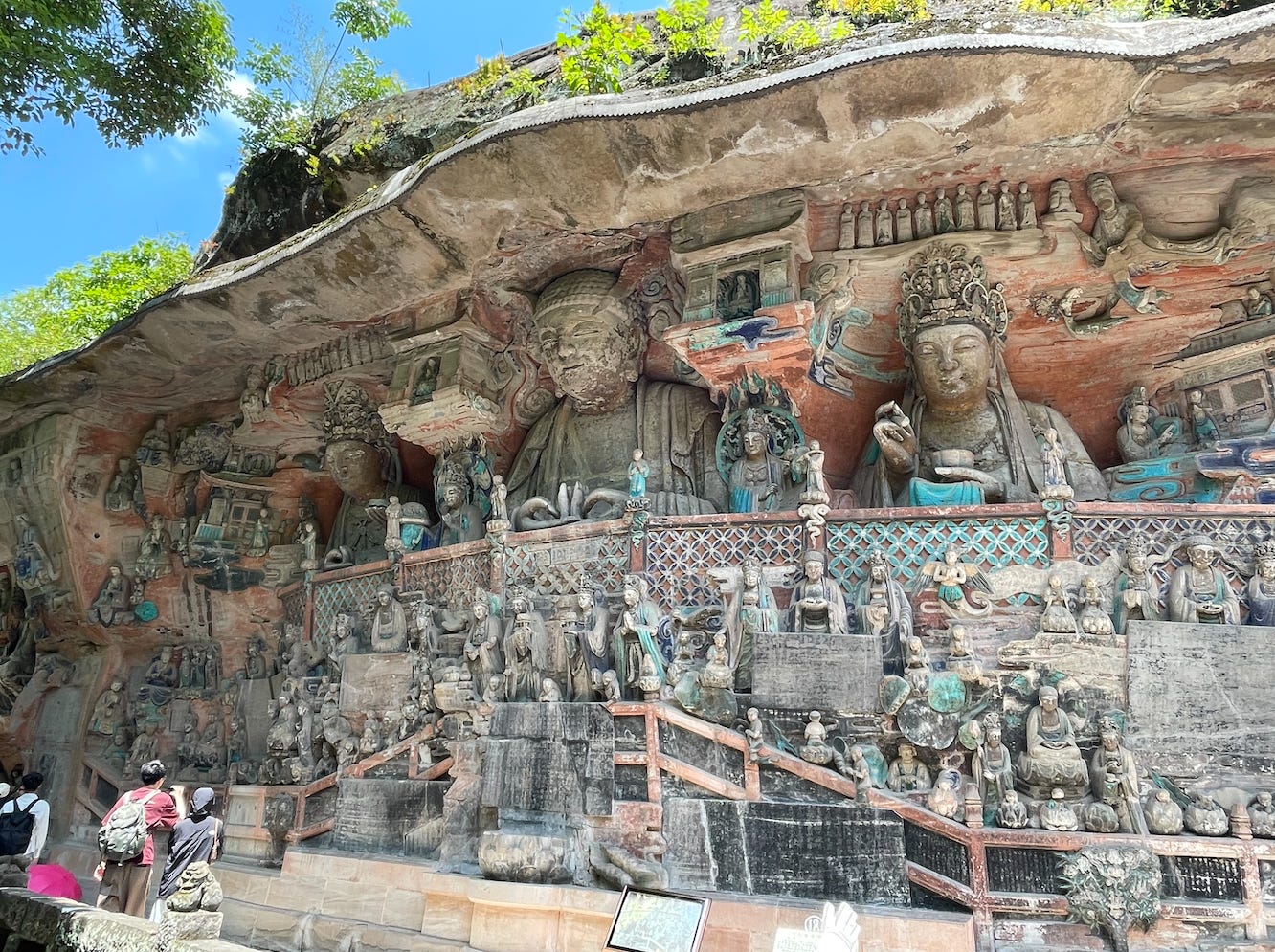
There are endless things to explore inside Chongqing itself, but if you have one extra day, I would leave the city center for a day trip to Dazu Rock Carvings 大足石刻. About a 1.5-hour drive away, Dazu is a group of cliff-carving sites spread across the district, with works dating mainly from the 9th to 13th centuries. It is a UNESCO World Heritage Site, and what makes it especially memorable is how human the carvings feel. Alongside Buddhist, Daoist, and Confucian imagery, the cliffs also turn to everyday life: parents and children, moral lessons, market activity, domestic care, punishment, devotion, and ordinary bodies moving through the world.
If you only have one day, focus on Baodingshan 宝顶山 and Beishan 北山. Baodingshan is the more dramatic and didactic site, largely associated with the Southern Song monk Zhao Zhifeng 赵智凤, with carvings arranged almost like a visual teaching program along the cliff. Beishan is older and quieter, with carvings begun in the late Tang and continued into later periods; its figures feel more intimate, devotional, and closely worked.
For anyone, especially a tea lover, I hope you visit Chongqing one day and let yourself get a little lost in it.
©2026 Studentoftea.com | All Rights Reserved