

For most of its history, tea was just tea. In the Tang dynasty (618–907 CE), scholars boiled it; in the Song (960–1279 CE), literati ground tea leaves into powder and whisked it into bright green froth. In these early writings, tea wasn’t categorized at all. So how did we get to today’s variety?
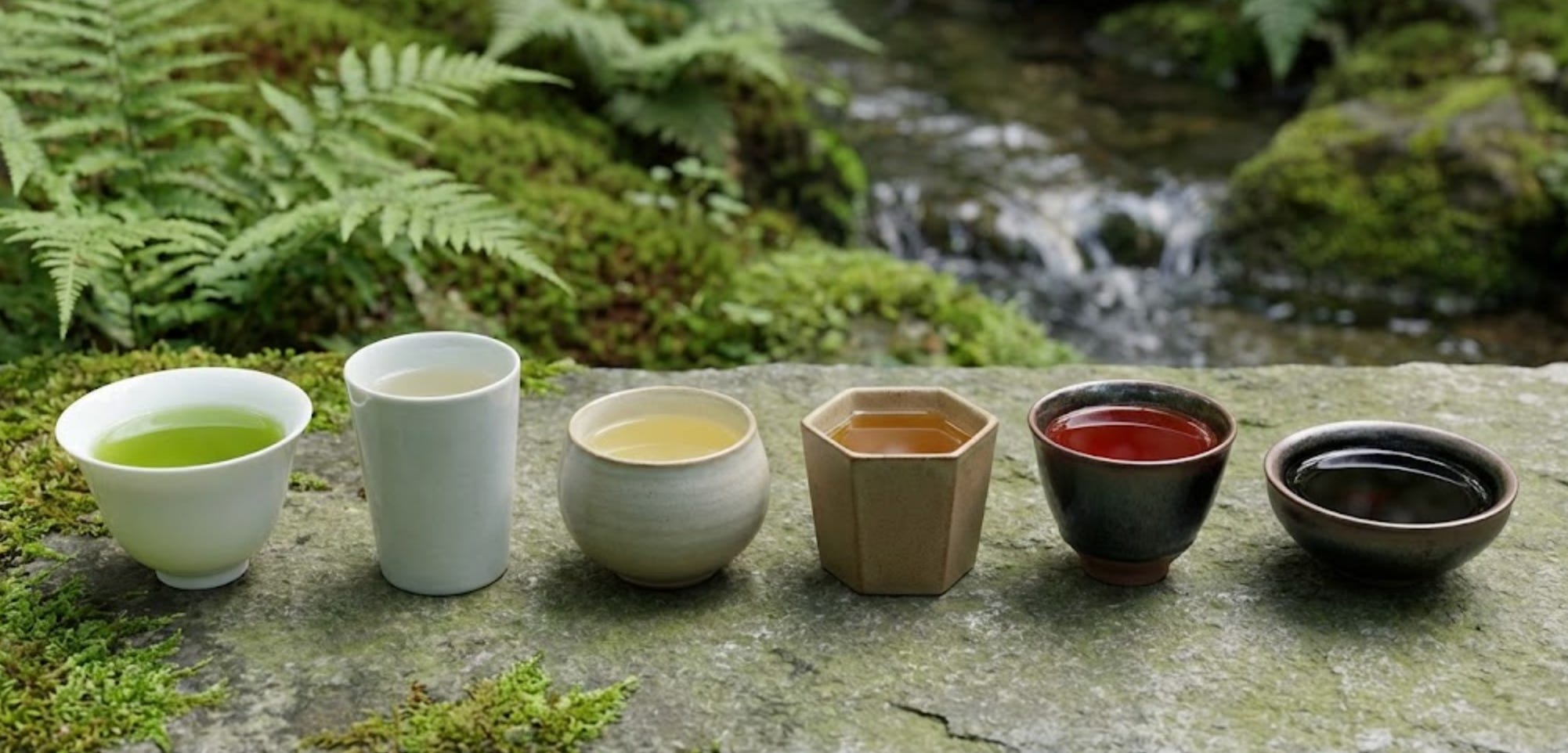
Green
Whether loose leaves or ground powder, records suggest that tea was at first green. In The Classic of Tea (茶经 760) by Lu Yu 陆羽 is the earliest known text to describe how tea was made. In Book Three: Making Tea, he outlined steps such as steaming, crushing, pressing, and drying the leaves.
When growing on the tree, tea leaves are green because they are rich in a molecule called chlorophyll. Chlorophyll is a pigment that captures sunlight for photosynthesis, in most leafy plants. Much like fruits you buy from the market, tea leaves begin to brown once they are picked off the tree. This browning is caused by an enzyme called polyphenol oxidase (PPO). When the leaf dies, the enzyme is released, allowing it to use oxygen to oxidize the polyphenols and turn them into brown pigments. Wait a minute, you may ask, what are polyphenols? Polyphenols are a family of natural compounds that contain multiple phenol groups. In tea, the main ones are flavonoids, especially catechins, and phenolic acids. When the enzyme PPO comes into contact with polyphenols in the presence of air, it catalyzes a series of oxidation reactions that turn the once-colorless polyphenols into pigments. Catechins, for example, transform into golden theaflavins and reddish-brown thearubigins.
By the time it reaches the cup, tea manages to stay green through heat. When freshly picked leaves are exposed to high temperatures (steaming, pan-firing, or roasting), the heat quickly deactivates the enzyme PPO that causes browning through oxidation. This process, known as “arrest the green” (杀青), stops browning before it begins and locks in the leaf’s natural color, aroma, and fresh taste. Are early Chinese tea makers chemists too?
During the Ming dynasty (14th–17th centuries), tea makers discovered that heating leaves in a dry pan produced brighter color and richer aroma than steaming. The earliest record of this shift appears in Cha Pu (茶谱, ca. 1440), written by Zhu Quan 朱权, the seventeenth son of the Hongwu Emperor. He described pan-fried teas as having a “clear fragrance and bright color,” and noted that they stored better than the steamed kinds. From that point on, frying gradually replaced steaming as the standard way to keep tea green.
Many of China’s most famous green teas were born from this tradition: the Dragon Well (龙井茶) from Hangzhou, Zhejiang; Bi luo chun (碧螺春) from Suzhou, Jiangsu; and Mao Feng (毛峰) from Huangshan, Anhui. Each uses heat to arrest oxidation, but the subtle differences in temperature, timing, and leaf handling give each tea its distinct aroma and texture.
White
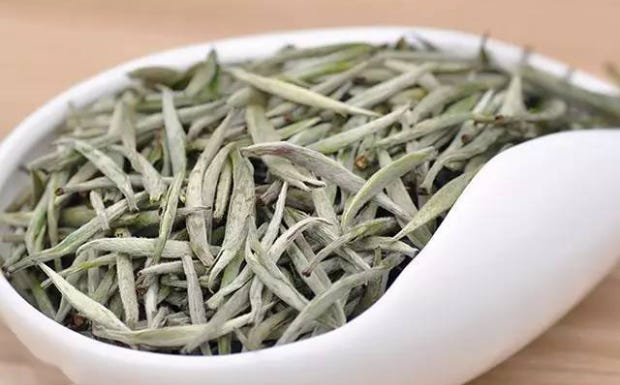
Some tea makers, however, took a gentler path. The term “white tea” 白茶 first appeared in the Song dynasty, when Emperor Huizong 徽宗 in his Treatise on Tea 大观茶论 (1107 CE) praised a rare tribute tea whose buds were “the most refined, like silver needles.” Back then, “white tea” referred only to the pale color of tea leaves, and not a specific way to preparation.
Centuries later, in the coastal mountains of Fujian, tea makers learned that tender spring buds could be dried in the sun without any heating at all. The Records of Fujian Products 闽产录异 (1568) first described this process and the Sequel to the Classic of Tea 茶续经 (1734) later called them “sun-dried white tea.” The result was pale and sweet, the fine white hairs on the buds giving the brew a silvery sheen while slow, natural oxidation softened the grassy notes of green tea into gentle hints of honey and hay.
Today you can find Baihao Yinzhen (白毫银针), Bai Mudan (白牡丹), Gong Mei (贡眉) and Shou Mei (寿眉) from Fujian Province; and Moonlight White (月光白) from Yunnan. Variations in leaf age, sunlight, and drying time give every tea its own balance of sweetness, body, and fragrance.
Yellow
Now, all tea makers make mistakes.
In a book Cha Shu (茶疏, 1597) by Xu Cishu 许次纾, he criticized local tea makers for over-firing their leaves so that “before they even came out of the wok, they were already scorched and withered.” Little did he know that what he saw as a bug, green tea turning yellow, would later become a feature.
Yellow teas began to appear in the late Ming (1600s), when tea makers discovered that gently reheating pan-fried leaves in a warm, humid cloth produced a mellower aroma and golden brew. The earliest surviving reference to a process resembling this is often attributed to Gu Yuanqing’s Cha Shuo (茶说, ca. 1590–1600 CE). Later, the technique gained its official name “sealing to yellow” (闷黄), appearing in the book Sequel to the Classic of Tea (茶续经, 1734) by Lu Tingcan 陆廷灿. In essence, the green pigment chlorophyll slowly faded, and the tea becomes softer, sweeter, and less grassy.
Many delicate yellow teas trace their origin to this discovery: Junshan Yinzhen (君山银针) from Dongting Lake, Hunan; Huoshan Huangya (霍山黄芽) from Anhui, Hunan; and Mengding Huangya (蒙顶黄芽) from Sichuan. Differences in leaf tenderness, heat, and wrapping time give every tea a unique own shade of gold and gentle sweetness.

Dark
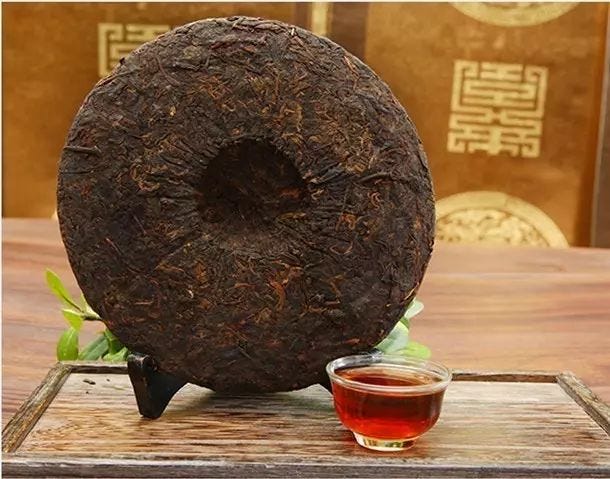
In Sichuan, green tea had to take a new direction. Merchants traveling the ancient Tea Horse Road (茶马古道) soon realized that green tea’s delicate fragrance and flavor couldn’t survive the long, humid journey across the mountains to Tibet and then central Asia. Dark tea (黑茶) appears in the Veritable Records of the Ming (明实录) as early as 1524. In Chinese, the term 黑茶 literally means ‘black tea,’ but to distinguish it from 红茶 (red tea, known in the West as black tea), it is now translated to dark tea. The official Ming records Collected Statutes of the Ming Dynasty (明会典, 1587) described that “border tea” was steamed and then pressed into cakes for transport. Although the records did not explicitly mention drying, the bricks must have been heated to prevent spoilage. That repeated drying likely deepened both color and aroma through browning reactions between the leaf’s sugars and amino acids. For anyone who enjoys baking bread or searing steak, this is the famous Maillard reaction.
The idea of darkened, durable tea must have spread east. In Hunan, tea makers refined the process further. By mid-18th century, brick teas from Anhua County had developed a new step called wet-piling (渥堆). We now know this process as fermentation, a slow transformation driven by naturally occurring microbes that thrive in the warm, humid piles of tea leaves. As they break down polyphenols and other compounds, the leaves darken, their bitterness softens, and a mellow, earthy aroma emerges.
Many of China’s most famous dark teas uses the same techniques: Fuzhuan tea (伏砖茶) from Anhua, Hunan; Liubao tea (六堡茶) from Wuzhou, Guangxi; and Shou Pu’er (熟普洱) from Yunnan. The microbes, moisture, and aging conditions unique to each region give them their distinct flavor and aroma.
Oolong
As dark teas evolved inland across Sichuan and Hunan, another experiment was unfolding on the southeastern coast. In the rugged Wuyi Mountains 武夷山 of Fujian Province (Yes, the same birth place of white teas), tea makers began to master the art of partial oxidation. Wuyi tea was first praised in writing in 1034 CE, when the statesman Fan Zhongyan 范仲淹 composed his Wuyi Tea Song (武夷茶歌): “By the stream grows a wondrous tea, the finest under heaven, long tended by the immortals of Wuyi”.
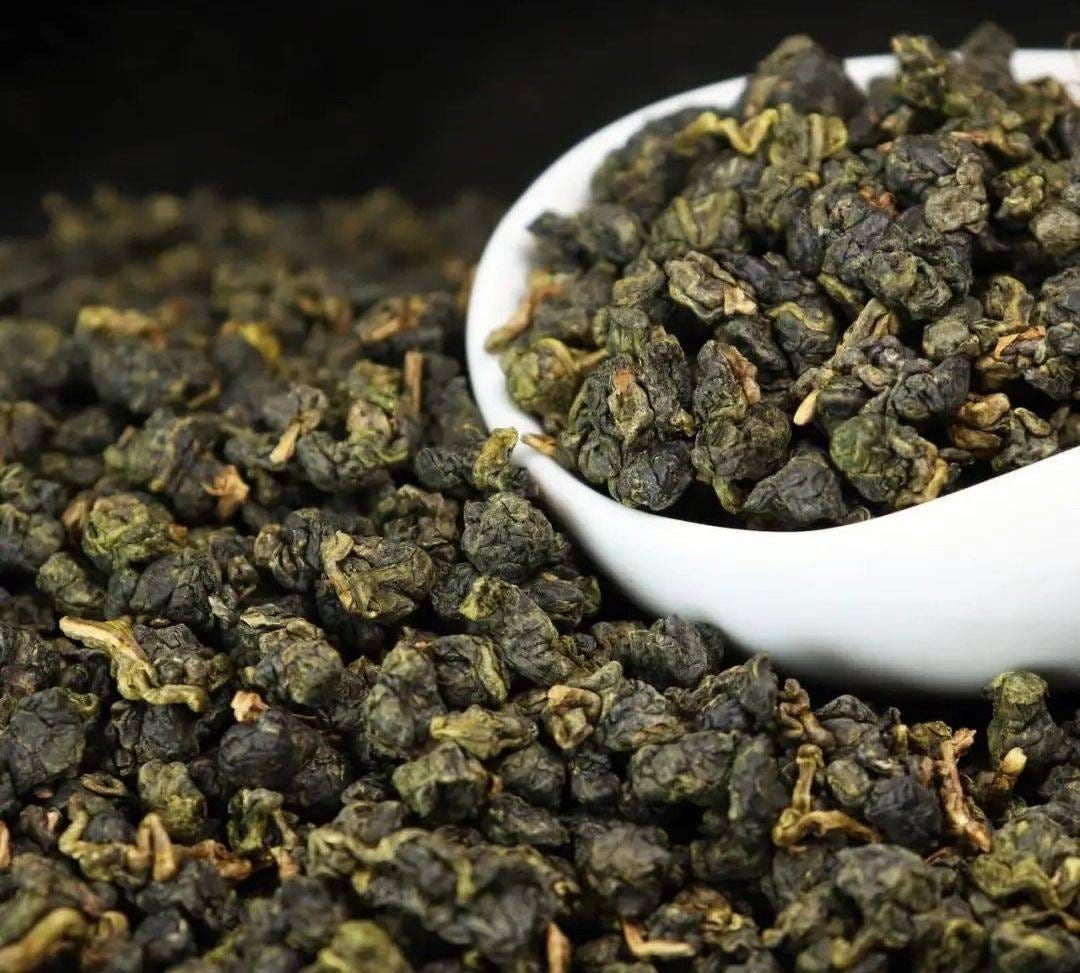
Instead of pan-firing leaves immediately after picking, Fujian tea makers allowed them to rest and gently shook them (摇青) in bamboo baskets, bruising the edges while keeping the centers green. The Longxi County Gazetteer (龙溪县志, 1732) seems to be the first record to mention this style of tea as Oolong tea (乌龙茶). The process of shaking and bruising allowed oxygen to reach the enzyme PPO inside the leaf, starting controlled oxidation of polyphenols, just as we discussed in the beginning. Fujian’s Da Hong Pao (大红袍) and Tie Guan Yin (铁观音) are some of the most famous oolongs descend from this tradition enjoyed until today.
By the mid-nineteenth century, Fujian’s oolong tradition had crossed the Taiwan Strait. Immigrants brought their tea bushes and craft to northern Taiwan, where the island’s misty hills gave rise to new classics such as Dong Ding (冻顶乌龙).
Black
Another turning point for tea took place deep in the Wuyi Mountains. In Tongmu Village 桐木关, tea makers began letting freshly picked leaves oxidize completely without heating them first. When the leaves were finally dried, the result was a smooth, copper-red brew. The earliest written evidence of black tea appears in Cha Kao (茶考, 1717) by Xu Cishu 许次纾, who described certain Wuyi teas as “red and fragrant in the cup” (汤色红而香). This brief line marks the first time a tea’s red color and aroma were highlighted as defining qualities. Black tea (Red in Chinese) was born.
While no record I could find clearly describes when this method first began, chemically it marked the far end of the oxidation spectrum. Without the initial “arrest the green” (杀青) step used in green tea production, the enzyme PPO continued to act on the leaf’s polyphenols, transforming them into brown and red pigments. The result was an amber liquor with a mellow, malty aroma.
In Wang Yinchang’s Cha Shuo (茶说, 1815), another key step was described: after withering, the leaves were hand-rolled to release their juices before oxidation. This rolling helped the enzymes and polyphenols mix evenly throughout the leaf, deepening the red color and enhancing the tea’s aroma.
Between 1848 and 1851, the botanist Robert Fortune, officially hired by the British East India Company (EIC), covertly gathered tea seeds, young plants, and processing tools from Fujian and Anhui, along with skilled Chinese tea workers. These were shipped to Kolkata and planted in the cool hills of Darjeeling and Assam. There, the Chinese black tea formed the foundation of India’s tea industry, marking the beginning of large-scale tea cultivation beyond China.
Today, the legacy of China’s red tea lives on in every region: Zheng Shan Xiao Zhong (正山小种) from Tongmu, Fujian, still carries its gentle pine aroma; Keemun (祁门红茶) from Anhui offers a winey fragrance and smooth body; and Dianhong (滇红茶) from Yunnan glows with golden buds and honeyed sweetness. The leaf variety, altitude, and drying method give each its own shade of red and character of taste.
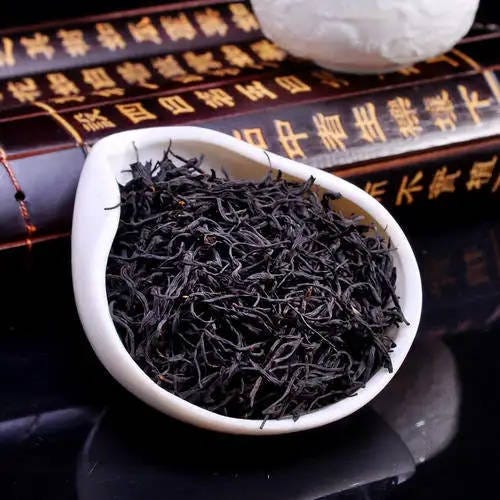
From green to white, yellow to dark, oolong to black, this is how six kinds of tea took shape. Each emerged not from sudden invention but from centuries of small experiments, adjusting heat, humidity, and time, to master the chemistry of a single leaf. What began as one plant became a spectrum of taste and color, its transformations guided by curiosity, patience, and craft.
What is your favorite cup of tea?
©2025 Studentoftea.com | All Rights Reserved